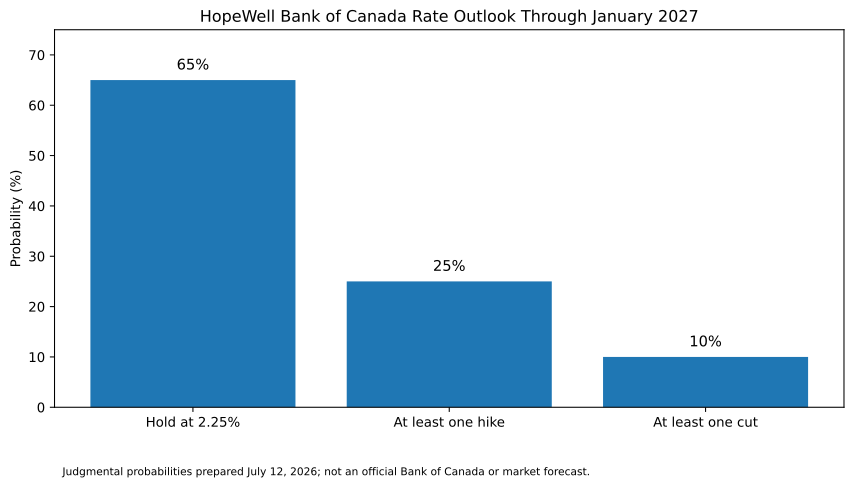
Current snapshot
The indicators shaping the forecast
The latest data do not point cleanly in one direction. Underlying inflation is considerably softer than headline CPI, while growth, housing and investment remain weak.
| Indicator | Latest reading | Policy signal |
|---|---|---|
| Bank of Canada overnight rate | 2.25% | Neutral starting point |
| Headline CPI, May 2026 | 3.2% | Hawkish at face value |
| CPI excluding gasoline | 2.2% | Much less alarming |
| CPI-trim / CPI-median | 2.0% / 2.1% | Near target |
| Real GDP, 2026 Q1 | 0.0% | Dovish |
| Real GDP per capita, 2026 Q1 | +0.2% | Complicates the stagnation story |
| Population, 2026 Q1 | −55,025 | Near-term demand drag |
| Unemployment, June 2026 | 6.5% | Soft, but not collapsing |
| Unit labour costs, 2026 Q1 | +1.4% q/q | Hawkish cost pressure |
| December 2026 implied CORRA | About 2.51% | Meaningful hike risk |
Borrower implications
What this forecast means for mortgage borrowers
The overnight-rate forecast matters most for variable products. Fixed rates can move independently because they are tied more closely to bond markets and lender funding costs.
Variable mortgages and HELOCs
Our base case suggests that variable mortgage and HELOC rates are more likely to remain broadly stable than to fall materially during the remainder of 2026. Borrowers should not rely on several cuts to make a payment affordable.
Fixed mortgage rates
Fixed rates can rise while the Bank holds if bond yields or funding spreads increase. They can also fall without a Bank of Canada cut if markets become more confident that future inflation and policy rates will be contained.
A fixed-versus-variable decision should also consider the actual rate difference, prepayment privileges, penalty methodology, expected holding period, refinance plans and the borrower’s ability to absorb payment volatility. Review HopeWell’s current Ontario mortgage rates and use the mortgage payment calculators to compare actual payment scenarios.
The core tension
Why the Bank is caught between opposing forces
Canada is experiencing a negative supply shock at the same time as domestic demand, housing and investment remain weak.
Forces against a hike
- Stagnant total GDP and weak final domestic demand
- Population contraction and slower household formation
- Soft housing, presales and residential investment
- Five consecutive quarterly declines in business capital investment
- Mortgage-renewal pressure on household cash flow
- Available business capacity and below-average hiring intentions
Forces against a cut
- Headline inflation above the Bank's 1%–3% control range
- Higher business and consumer inflation expectations
- Rising energy, freight and imported-input costs
- Weak productivity and increasing unit labour costs
- Canadian-dollar risk if the rate gap with the United States widens
- CORRA futures assigning meaningful weight to higher overnight rates
In a normal demand-driven inflation cycle, strong spending and a tight labour market make higher rates a relatively direct response. In a normal recession, falling demand and declining inflation make lower rates more straightforward. Canada’s current combination is closer to stagflationary pressure: weaker activity alongside higher supply-driven prices.
The Bank’s June deliberations acknowledged unusually elevated risks on both sides. Governing Council discussed how persistent generalized inflation could require a higher policy path, while a significant worsening of trade conditions could require support for economic activity. See the June 2026 Governing Council deliberations.
Inflation
Headline CPI is high—but the composition changes the policy response
May’s 3.2% inflation rate was heavily influenced by gasoline. The Bank will focus on whether that shock spreads into a broad and persistent inflation process.
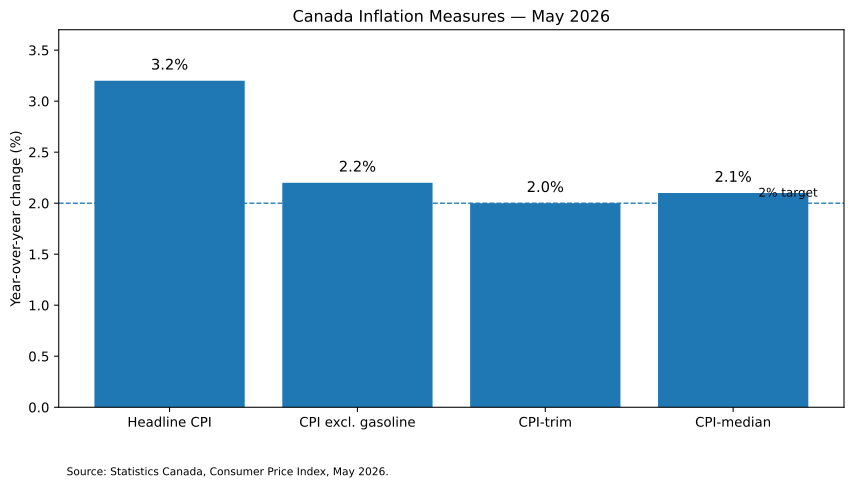
Statistics Canada reported that CPI rose 3.2% year over year in May, compared with 2.8% in April. Gasoline prices were 33.2% higher than a year earlier. Excluding gasoline, inflation was 2.2%. CPI-trim and CPI-median were 2.0% and 2.1%. See the May 2026 CPI release.
First-round and second-round inflation are not the same
First-round effect
Oil rises, so gasoline, heating, freight, airline travel and production inputs become more expensive. This effect may fade when energy prices stabilize.
Second-round effect
Businesses repeatedly reset prices, workers demand compensation, service prices accelerate and inflation expectations become embedded in future decisions.
Interest rates cannot produce more oil or repair a disrupted international supply chain. They can only reduce Canadian demand. Raising rates in response to every temporary energy increase could therefore weaken an already stagnant economy without addressing the source of the initial shock.
The Bank cannot ignore energy either. Fuel enters freight, food distribution, agriculture, manufacturing and services. The second-quarter Business Outlook Survey found that firms expected inflation one and two years ahead in the 3%–3.5% range, largely because of oil. But many firms also reported weak pricing power, and shorter-term expectations began easing after geopolitical conditions improved. See the second-quarter Business Outlook Survey.
Growth and capacity
Canada's economy is stagnant—but flat GDP does not automatically require a cut
Total output is weak. Yet slower population and labour-force growth are also reducing the economy’s potential growth rate.
Real GDP was unchanged in the first quarter of 2026 after declining 0.2% in the fourth quarter of 2025. Final domestic demand edged lower. Business capital investment declined for a fifth consecutive quarter, while residential investment fell 2.0% and resale-related activity fell 9.9%. See Statistics Canada’s first-quarter GDP release.
Those are genuine signs of domestic weakness. But real GDP per person increased 0.2% because total output was flat while population declined. That distinction matters. The Bank does not target total GDP growth. It assesses whether actual output is above or below the economy’s sustainable productive capacity.
Weak business investment is especially important. It reduces current demand, which is disinflationary. But persistent underinvestment also reduces future productive capacity and productivity, which can make the economy inflation-prone at lower growth rates. Monetary policy must account for both time horizons.
Population and immigration
Immigration restraint is a demand shock and a supply shock
The near-term effect is likely dovish, but the long-term effect is more complicated than simply assuming fewer newcomers must produce lower rates.
Statistics Canada estimated that Canada’s population declined by 55,025 people in the first quarter of 2026, the second consecutive quarterly decline. The estimate is preliminary and will be revised as more complete administrative information becomes available. See the first-quarter population estimates.
The federal 2026–2028 Immigration Levels Plan targets 385,000 new temporary-resident arrivals in 2026 and 370,000 in each of 2027 and 2028, while aiming to reduce temporary residents to below 5% of the population by the end of 2027. These are gross arrival targets—not net population growth. Departures, permit expirations, extensions and conversions to permanent residence determine the final population effect. See the federal immigration levels plan.
Demand falls quickly
Fewer new residents and more departures reduce incremental demand for rentals, home purchases, groceries, furniture, transportation, education, telecommunications, restaurants and consumer credit.
Potential output also slows
Fewer workers, entrepreneurs and consumers reduce labour-force growth, potential production and the long-run tax base. Canada can reach capacity at a lower total GDP growth rate.
The timing is asymmetric. A departing resident stops paying rent and making local purchases immediately. The apartment, store, college campus or restaurant built for rapid population growth remains in place. For several quarters, businesses may face excess capacity and weaker pricing power before they reduce staffing, investment or physical capacity.
That makes the immigration reversal primarily disinflationary over the next six months. Over a longer period, however, lower labour supply, weaker capital formation and cancelled construction can reduce potential growth and create future supply constraints.
Housing and household cash flow
Housing weakness and mortgage renewals reinforce the case for caution
A 2.25% policy rate does not fully describe the effective restraint experienced by households renewing pandemic-era mortgages.
The housing transmission chain
- 1Population and household formation slow.
- 2Rental and resale demand weakens.
- 3Investor expectations and condominium presales deteriorate.
- 4Projects fail to meet construction-financing thresholds.
- 5Construction, real-estate and related employment soften.
- 6Furniture, renovation and housing-related consumption decline.
This is predominantly disinflationary in the near term. The longer-term result can be paradoxical: if weak presales cause large project cancellations, completions may eventually fall below future household formation when population growth resumes. Housing can therefore reduce inflation today while worsening future affordability.
Mortgage renewals are delayed monetary tightening
Bank of Canada staff estimated that about 60% of mortgage holders renewing in 2025 and 2026 would experience a payment increase. Compared with December 2024 payments, the average payment for those renewing in 2026 was projected to be about 6% higher, although outcomes vary substantially by product and borrower. See the Bank’s mortgage-renewal analysis.
Many fixed-rate borrowers did not experience the full effect of earlier policy-rate increases until renewal. Their personal financial conditions can continue tightening even after the Bank stops increasing rates. Higher payments reduce discretionary spending, savings and additional borrowing capacity.
The renewal wave is a drag, not presently a systemic crisis. The Bank’s 2026 Financial Stability Report found that mortgage arrears remained low overall, although stress was more concentrated among highly leveraged borrowers and certain Toronto-area cohorts. See the household financial-stability assessment.
Labour and productivity
The labour market is soft, while productivity creates an inflation risk
A lower unemployment rate does not necessarily mean labour demand is strong when population growth and labour-force participation are changing.
Employment increased by 18,000 in June and the unemployment rate declined to 6.5%. The employment rate rose to 60.8%. However, annual employment growth remained modest, and manufacturing employment was still materially below its January 2025 peak. See the June Labour Force Survey.
When population and labour-force growth slow, the unemployment rate can stabilize or decline without rapid job creation. The Bank will therefore examine employment, participation, total hours, vacancies, job-finding rates, layoffs and wage growth—not merely the headline unemployment rate.
Productivity is the strongest domestic argument for a hike
Business labour productivity fell 0.5% in the first quarter. Hourly compensation increased 0.9%, causing unit labour costs to rise 1.4% in one quarter—the fourth consecutive quarterly increase. See Statistics Canada’s productivity and unit-cost release.
Unit labour costs measure the labour compensation required to produce one unit of output. If compensation rises while productivity falls, businesses must raise prices, accept lower margins, reduce employment or invest in productivity. Weak demand currently limits pricing power, but persistent productivity declines make it harder for inflation to settle sustainably at 2%.
Financial markets
Bonds warn against assuming cuts—but they do not guarantee a hike
Long-term bond yields contain policy expectations, inflation compensation, term premium, government borrowing and global-rate effects.
The Bank of Canada’s first-quarter Market Participants Survey found that the median respondent expected the policy rate to remain at 2.25% at every 2026 meeting. Yet the same respondents forecast end-of-2026 yields of 2.70% for the two-year Government of Canada bond, 3.10% for the five-year bond and 3.45% for the ten-year bond.
That combination demonstrates why a five-year yield above 3% cannot be translated directly into “the Bank will hike.” Bond yields also contain future-rate expectations beyond six months, inflation risk, term premium, sovereign-bond supply, liquidity and movements in US and global yields.
The survey nevertheless contained a hawkish risk skew: 40.8% of respondents saw risks tilted toward a higher policy path, compared with 22.2% tilted lower. See the Market Participants Survey.
Higher bond yields can do part of the Bank’s work
Rising yields increase fixed mortgage rates, business borrowing costs, construction financing and government debt-service costs. This tightens financial conditions even when the overnight rate remains at 2.25%. A hawkish bond market can therefore reduce the need for the Bank itself to hike.
CORRA futures give a more direct short-rate signal
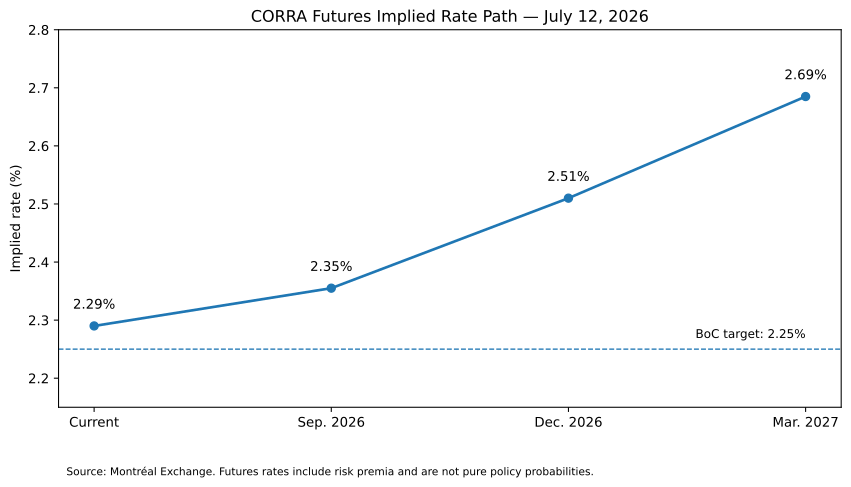
Montréal Exchange pricing showed actual CORRA at 2.29%, the September 2026 three-month contract implying 2.355%, December implying 2.51% and March 2027 implying 2.685%. See the Canadian Interest Rate Expectations Tool.
This is clearly more hawkish than an expectation of immediate cuts. But a three-month futures contract reflects the average compounded overnight rate over a quarter, not only one meeting. Prices also incorporate risk premiums and insurance against a higher-rate outcome. The correct conclusion is that a hike is a meaningful tail—not that it is the single most likely outcome.
External and policy risks
The Canadian dollar, fiscal policy and trade can overturn the base case
These channels can change both demand and inflation, sometimes in opposite directions.
The Canadian dollar limits the Bank’s freedom to cut
A weaker Canadian dollar raises the domestic price of imported food, vehicles, machinery, electronics, pharmaceuticals and industrial inputs. A cut that widens the Canada–US rate differential could add downward pressure to the currency, although oil, trade policy and global risk sentiment also matter.
The Bank does not need to match the US Federal Reserve. Canada has an independent monetary policy and a floating exchange rate. But a sharp currency decline while energy inflation is elevated would make a cut harder to justify.
Fiscal policy can support demand and lift long yields
Infrastructure, defence, housing and industrial programs can support employment and investment while private demand is weak. If spending adds to demand faster than it expands supply, it can reduce the need for cuts and eventually add inflation pressure. Additional government borrowing can also increase long-term yields through bond supply and term premium without implying an imminent Bank of Canada hike.
Canada–US trade policy is the largest two-sided risk
New trade restrictions could reduce exports, delay investment, weaken manufacturing, raise layoffs, disrupt supply chains and pressure the Canadian dollar. This would not necessarily be a cleanly deflationary shock. Tariffs can reduce output while increasing prices.
A severe employment and demand shock would increase the probability of a cut. A tariff-and-currency shock that lifted inflation expectations without causing deep unemployment could increase the probability of a hike. The Bank’s response would depend on the balance between lost demand and higher costs.
Probability framework
HopeWell's three Bank of Canada scenarios
The probabilities are not claims of certainty. They are a disciplined way to compare the relative strength of competing macroeconomic paths.
Base case: hold at 2.25%
65%Energy remains volatile but does not continually accelerate. Core inflation stays near 2%. Weak demand limits pass-through. Population growth remains subdued, housing and investment stay soft, and mortgage renewals restrain consumption. The energy sector and government activity prevent a deep recession.
Hawkish case: at least one increase
25%Core inflation rises, services and non-energy goods accelerate, firms pass costs through, inflation expectations remain above 3% after oil stabilizes, productivity stays weak, unit labour costs rise and the Canadian dollar depreciates. The most likely result would be one 0.25% increase to 2.50% in October or December.
Dovish case: at least one reduction
10%Population contraction continues, employment and hours fall, unemployment rises, business investment and household spending weaken, rent and construction soften, core inflation falls below target, or a major trade shock damages exports and manufacturing. The most likely result would be one 0.25% cut to 2.00%.
Calendar
Meeting-by-meeting Bank of Canada outlook
The July decision is the clearest. October and December are the meetings at which the accumulated evidence could justify a move.
| Meeting | Base case | What matters |
|---|---|---|
| July 15, 2026 | Hold | Updated Monetary Policy Report; June CPI arrives after the decision |
| September 2, 2026 | Hold | More CPI and labour data, but limited new quarterly GDP evidence |
| October 28, 2026 | Live meeting | Inflation breadth, revised outlook, trade and population effects |
| December 9, 2026 | Live meeting | Best opportunity for a 0.25% move if one side becomes dominant |
The Bank’s official schedule confirms announcements on July 15, September 2, October 28 and December 9, all at 9:45 a.m. Eastern Time. The July and October decisions are accompanied by Monetary Policy Reports. See the 2026 Bank of Canada schedule.
Falsification tests
What would make us change the forecast?
A serious forecast must identify the evidence that would prove its current assumptions wrong.
Raise the hike probability if
- CPI-trim and CPI-median rise persistently above target.
- Inflation breadth expands across services and non-energy goods.
- Business pricing power and pass-through strengthen.
- Inflation expectations stay high after oil stabilizes.
- Wages outpace productivity and unit labour costs continue rising.
- The Canadian dollar weakens materially.
- CORRA and two-year yields remain hawkish after geopolitical volatility fades.
Raise the cut probability if
- Population declines continue after revisions.
- Employment and total hours begin falling.
- Unemployment rises despite a smaller labour force.
- Final domestic demand and household consumption contract.
- Rent growth, housing turnover and construction weaken sharply.
- Core inflation falls below 2%.
- Trade restrictions materially damage exports and manufacturing.
Questions borrowers ask
Frequently asked questions
Will the Bank of Canada cut interest rates in 2026?+
A cut is possible, but it is not HopeWell's base case as of July 12, 2026. We assign a 10% probability to at least one cut through January 2027. A cut would become more likely if employment, final domestic demand, housing and core inflation weakened materially.
Will the Bank of Canada raise rates in 2026?+
HopeWell assigns a 25% probability to at least one increase through January 2027. A hike would require stronger evidence that energy and tariff-related price pressure is spreading into services, wages, non-energy goods and inflation expectations.
What is the most likely Bank of Canada rate at the end of 2026?+
HopeWell's central forecast is that the overnight policy rate will remain at 2.25% at the end of 2026.
When is the next Bank of Canada interest-rate announcement?+
The next scheduled announcement after this article's July 12, 2026 data cutoff is July 15, 2026. The remaining 2026 announcements are September 2, October 28 and December 9.
Can fixed mortgage rates fall without a Bank of Canada cut?+
Yes. Fixed mortgage rates are influenced mainly by Government of Canada bond yields, expected future interest rates, lender funding costs and mortgage-market competition. They can move while the overnight rate remains unchanged.
Does lower immigration automatically mean lower interest rates?+
No. Lower immigration reduces housing and consumer demand, but it also slows labour-force growth and potential output. The near-term effect is likely disinflationary, but the long-term effect is more complicated.
Why might the Bank hold when inflation is above 3%?+
Much of the May 2026 acceleration came from gasoline. CPI excluding gasoline and the Bank's preferred core measures were much closer to 2%. The Bank will focus on whether the energy shock spreads broadly and persists.
Should a borrower choose fixed or variable solely from this forecast?+
No. The decision should also reflect actual available rates, payment affordability, penalties, prepayment rights, expected holding period, refinance plans and tolerance for payment uncertainty.
Transparency
Methodology, limitations and update policy
The page distinguishes verified data, survey expectations, market pricing and HopeWell’s own analytical judgment.
- The forecast uses Bank of Canada communications, Statistics Canada data, CORRA futures, bond-market surveys, immigration policy and mortgage-renewal research.
- Market prices are not treated as pure probabilities because they include risk premia, timing effects, hedging demand and liquidity.
- Population estimates are preliminary and may be revised as administrative data improve.
- The 65% / 25% / 10% probabilities are HopeWell's judgmental estimates, not official forecasts.
- The page will be materially updated after Bank of Canada decisions and when new data alter the scenario probabilities.
Update log
July 12, 2026 — Initial publication
Added the probability framework, May inflation data, first-quarter GDP and population data, June employment, second-quarter Bank surveys, mortgage-renewal analysis and July CORRA pricing.
Primary sources
- 1.Bank of Canada — June 10, 2026 policy-rate announcement
- 2.Bank of Canada — June 2026 Governing Council deliberations
- 3.Statistics Canada — Consumer Price Index, May 2026
- 4.Statistics Canada — CPI core measures, May 2026
- 5.Statistics Canada — GDP, income and expenditure, first quarter 2026
- 6.Statistics Canada — Population estimates, first quarter 2026
- 7.Statistics Canada — Labour Force Survey, June 2026
- 8.Statistics Canada — Productivity and unit labour costs, first quarter 2026
- 9.Bank of Canada — Business Outlook Survey, second quarter 2026
- 10.Bank of Canada — Canadian Survey of Consumer Expectations, second quarter 2026
- 11.Bank of Canada — Market Participants Survey, first quarter 2026
- 12.Montréal Exchange — Canadian interest-rate expectations
- 13.Government of Canada — 2026–2028 Immigration Levels Plan
- 14.Bank of Canada — Mortgage-payment changes at renewal
- 15.Bank of Canada — Financial Stability Report 2026: Households
- 16.Bank of Canada — 2026 policy announcement schedule
Apply the forecast to your mortgage
Compare the actual mortgage options—not only the economic headlines.
HopeWell Mortgages can review available fixed and variable terms, penalties, prepayment rights, payment sensitivity and qualification based on your specific circumstances.
Financial-information disclaimer
This article provides general economic and mortgage-market information. It is not an official Bank of Canada forecast and does not constitute individualized mortgage, investment, legal, accounting or tax advice. Forecasts are inherently uncertain. Rates, bond yields, qualification rules and lender guidelines can change without notice. Mortgage products are subject to lender approval, borrower qualification, property review, income, credit, equity and documentation requirements.