Bank of Canada Rate Forecast 2026: Cut, Hold or Hike?
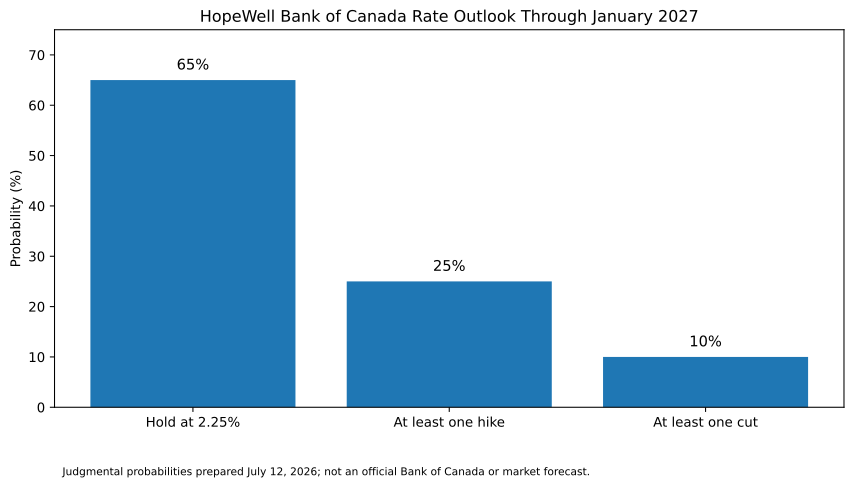
HopeWell's probability-based analysis of inflation, bonds, CORRA futures, immigration, stagnant GDP, housing, mortgage renewals, productivity and Canada-US trade risks.
Evidence-based market analysis and practical mortgage education for Ontario homeowners, buyers, investors and business owners.
Featured analysis
HopeWell's probability-based analysis of inflation, bonds, CORRA futures, immigration, stagnant GDP, housing, mortgage renewals, productivity and Canada-US trade risks.
Latest publications
Explore practical Ontario mortgage analysis covering private lending, refinancing, qualification, mortgage costs and changing market conditions.
Missed a mortgage payment in Ontario? Learn what can happen next, what changes after one missed payment, how credit and legal risk develop, and what to do first.
A practical Ontario action plan for homeowners one month behind on a mortgage: cure the arrears, assess hardship relief, protect equity, and decide whether refinancing is justified.
There is no universal mortgage grace-period rule. Learn how late payments move from a servicing issue to credit, renewal and power-of-sale risk in Ontario.
Compare ways to catch up mortgage arrears in Ontario—from lender payment arrangements and capitalization to refinance, second mortgages, private financing and voluntary sale.
Understand the difference between mortgage delinquency, arrears and default in Canada—and why the legal, credit and refinancing consequences are not identical.
A stage-by-stage Ontario guide to mortgage default: lender contact, arrears, credit impact, demand, power of sale, refinance options, equity and possible deficiency risk.
Mortgage default can involve more than missed monthly payments. Learn how payment, tax, insurance and other mortgage covenants can create default risk in Ontario.
Yes, some mortgages in arrears can be refinanced. Learn how Ontario lenders assess equity, income, credit, legal stage, payout timing and exit strategy in distressed refinances.
Mortgage default can affect more than today's payment. Learn how recent arrears can influence credit, renewal leverage, lender switching and refinance options in Canada.
Ontario does not use a simple three-payment rule for power of sale. Learn how continued default, mortgage terms, statutory notice periods and lender action actually shape the timeline.
A practical Ontario timeline from mortgage default to Notice of Sale, redemption period, possession and lender sale—and why there is no single fixed number of days.
Power of sale and foreclosure are not the same. Learn who owns and sells the property, what happens to equity, and why Ontario borrowers usually encounter power of sale.
Mortgage default does not automatically erase your equity, but arrears, legal costs, interest, later mortgages and a forced sale can consume it. Learn how to calculate usable equity.
Yes, a second mortgage is real security. Learn how a second mortgagee can enforce, how first-mortgage priority affects the economics, and what borrowers should do after default.
Searching for a foreclosure bailout loan in Ontario? Learn how power-of-sale rescue mortgages work, what they cost, how equity is assessed, and when a bailout is not the best answer.
Refinancing or a second mortgage can sometimes stop Ontario power of sale if it funds in time. Compare reinstatement, full refinance, second mortgage, private rescue and voluntary sale.
If your mortgage lender says it will not renew, the problem is serious but not automatically catastrophic. Learn the five routes to a new mortgage, the renewal timeline, switching rules and how to avoid a maturity-day crisis.
Banks do not refuse mortgage renewals for one universal reason. This guide separates payment-conduct, credit, property, covenant and lender-policy causes—and explains what each one means for your next move.
Bad credit can complicate a mortgage renewal without ending your options. Learn how to separate score from credit story, compare A, B and private routes, and build a measurable path back to lower-cost financing.
When mortgage arrears collide with maturity, the borrower faces both a payment-conduct problem and a deadline. Learn how to assess cure, payout, refinance, second-mortgage and private options before renewal.
A bank non-renewal does not automatically prevent a switch. Learn the difference between a straight switch and refinance, current stress-test treatment, incoming-lender underwriting, and when an alternative solution is needed.
“B lender” is mortgage-industry shorthand, not a legal grade. Learn how alternative lenders differ from prime banks and private lenders, who they may fit, what they underwrite, and how to plan an exit.
Compare A, B and private mortgage lenders by underwriting philosophy, income evidence, credit, property, leverage, term, fees, speed and exit—not by labels alone.
There is no single B-lender mortgage rate. Learn the risk factors, fees, property and borrower variables that build an alternative-mortgage price—and how to compare offers on true expected cost.
Alternative lenders assess more than credit score. Use this four-corner framework—income, credit, equity and property—to understand B-lender mortgage qualification in Ontario.
There is no universal B-lender equity rule. Learn why purchase down payment and refinance equity are different questions, how LTV is calculated, and what can reduce usable equity.
Often, yes—but “bad credit” is not one risk. Learn how B lenders can assess recency, severity, mortgage history, equity, income and recovery direction, and when private financing may be more appropriate.
Self-employed does not automatically mean B lender. Learn how to exhaust prime income analysis first, then compare alternative documentation, business cash flow, add-backs, property and exit strategy.
Searching for private mortgage lenders in Ontario? Learn how the private-lending market is structured, how lenders differ, what they underwrite, and how to compare a lender before accepting short-term financing.
Private mortgage underwriting is more than “equity lending.” Learn the seven questions Ontario private lenders can ask about property, title, LTV, borrower, purpose, carry and exit.
Use an all-in private-mortgage cost framework that combines rate, lender and brokerage fees, legal costs, appraisal, interest reserves, renewal risk and the expected holding period into comparable dollars.
Use a three-gate decision framework to decide whether private financing creates enough value to justify its cost—or merely converts home equity into time without solving the underlying problem.
The best private-mortgage exit starts on day one. Use this month-by-month Ontario roadmap to improve credit, income evidence, debt ratios, property condition and timing before private maturity.
A mortgage deferral delays payments; it does not erase them. Learn current FCAC guidance, how principal and interest are affected, eligibility considerations, credit treatment and when another relief option may be better.
Mortgage relief is a menu, not a single deferral. Compare special arrangements, deferrals, capitalization, amortization extensions, interest-only payments, refinancing, debt restructuring and sale in a rational sequence.
Searching for a “2026 homeowner relief program”? Separate real mortgage-hardship measures from housing rebates, benefits and marketing claims. Here is what Canadian and Ontario homeowners should verify.
A mortgage deferral is only one tool. Compare alternatives by whether the problem is temporary or structural: payment changes, amortization, interest-only, capitalization, refinance, second mortgage, debt consolidation and sale.
A practical Ontario guide explaining private mortgage costs, including appraisal, lender fees, brokerage fees, legal fees, title insurance, interest rate, net proceeds, renewal risk, and exit strategy.
A practical Ontario guide debunking common private mortgage myths, including myths about bad credit, no-income lending, rates, fees, approvals, second mortgages, exit strategies, and borrower risk.
A practical Ontario guide to private mortgage interest rates, including what affects pricing, why rate alone can be misleading, and how borrowers should review total cost and exit strategy.
A practical Ontario guide comparing private mortgages and bank mortgages, including lender mindset, approval criteria, cost, timing, rate sensitivity, risk, and exit strategy.
A practical Ontario guide explaining who may review private mortgage options, including homeowners, self-employed borrowers, investors, business owners, retirees, and borrowers with short-term financing challenges.
A practical Ontario homeowner guide to private mortgages, including when they may be reviewed, how lenders assess equity, what costs to expect, and why an exit strategy matters.
Learn what a private mortgage in Ontario is, when it may be reviewed, who provides private mortgage funds, what lenders look at, and why cost and exit strategy matter.
Learn how to review private mortgage options in Ontario, including costs, risks, lender expectations, repayment capacity, and exit strategy before proceeding.
Economic analysis cannot determine the right mortgage by itself. Product pricing, penalties, prepayment rights, qualification, expected holding period and payment risk still require an individual review.